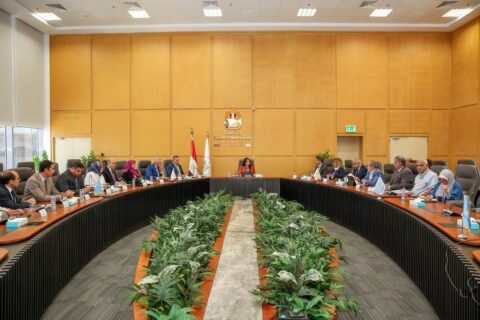
Eng. Randa El-Menshawy, Minister of Housing, Utilities and Urban Communities, held a meeting to review the latest progress on the Fustat Hills Gardens Project, a landmark development spanning 500 feddans in the historic Fustat area of Old Cairo, Cairo Governorate, invest-gate reports.
The project is being implemented by the Central Agency for Reconstruction, an affiliate of the Ministry of Housing. The meeting was attended by Eng. Khaled Sediek, Chairman of the Urban Development Fund; Major General Hany El-Eskandarany, Head of the Central Agency for Reconstruction; along with ministry officials and the project consultant.
Minister Randa El-Menshawy emphasized the state’s strong commitment to the development of the Fustat area, one of Cairo’s most important historical and cultural destinations. She noted that the Fustat Hills Gardens Project represents a major step toward revitalizing the area and restoring its distinctive urban character by creating an integrated recreational and tourism destination offering a wide range of leisure, cultural, service, and investment opportunities.
She explained that the project seeks to unlock the site’s full potential and maximize its value by making the most of its unique natural and historical assets. The development will feature extensive open spaces, recreational facilities, cultural venues, and a range of services designed to provide an exceptional experience for both residents and visitors.
The Minister also underscored the importance of preserving Fustat’s historic character and urban identity, stressing that the Ministry is committed to delivering the project to the highest standards in keeping with the area’s historical and cultural significance. The project is also expected to enhance Fustat’s appeal to residents, tourists, and investors.
Reviewing Progress Across the Project’s Key Zones
During the meeting, officials presented an update on the implementation of the various components of the Fustat Hills Gardens Project, including the Investment Zone and Arena.
Covering 131,000 square meters and overlooking Ain Al-Hayat Lake, the Investment Zone will feature 12 restaurants, four shopping malls, and four parking garages. It will also include a dedicated rear area for major official celebrations and events, featuring a Roman-style theater, a water fountain, and extensive landscaping works.
Minister El-Menshawy also reviewed progress on the Cultural Zone and River Zone. Located opposite the project’s main entrance, the Cultural Zone is centered around a major axis facing the National Museum of Egyptian Civilization, with a series of plazas designated for cultural activities, restaurants, and various services.
The zone also includes the project’s main entrance, four restaurants and cafés, three fountains, and built-up facilities covering 216 square meters. In addition, an area of 26,864 square meters has been allocated to accommodate celebrations and events throughout the year.
The meeting further reviewed the implementation of the Adventure Zone, which includes a number of service facilities, lakes, landscaped areas, and a recreational games area. The zone features three service buildings: a 505-square-meter children’s games facility, a 167-square-meter service building, and a 167-square-meter restroom facility. Utility infrastructure and landscaping works cover an area of 97,238 square meters.
The Minister also reviewed progress on the Hills and Valley Zone, which comprises three hills of varying elevations, with the “River” waterway running between them. The hills are designed with a series of cascading terraces extending from the river’s edge to the hilltops, creating elevated vantage points with distinctive views of the project, the surrounding area, and the Citadel of Salah El-Din.
Market Zone to Promote Tourism and Preserve Traditional Crafts
The meeting also addressed progress on the Market Zone, a 60,000-square-meter commercial district designed to boost tourism, support the national economy, and preserve and promote traditional handicrafts and heritage industries.
The zone will showcase a range of traditional crafts, including glassmaking, ceramics, candle-making, spinning, and weaving. The development is being implemented in three phases and will include 19 retail shops, parking facilities, an artificial lake, landscaped green areas, and a three-star hotel.
Concluding the meeting, Minister Randa El-Menshawy stressed the importance of maintaining regular field inspections across all components of the project, ensuring close coordination among all relevant authorities, contractors, and the project consultant, and swiftly addressing any challenges that may affect the pace of implementation.