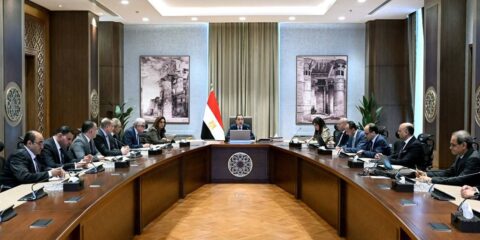
Prime Minister Dr. Mostafa Madbouly held a meeting today to review the implementation status of a number of service and development projects in Cairo Governorate, in the presence of Dr. Manal Awad, Minister of Local Development and Environment; Eng. Randa El-Menshawy, Minister of Housing, Utilities and Urban Communities; Major General Dr. Khaled Fouda, Advisor to the President for Local Development and Chairman of the National Committee for the Protection and Development of Historic Cairo; Dr. Ibrahim Saber, Governor of Cairo; Eng. Khaled Sediek, Chairman of the Urban Development Fund; along with a number of officials from the relevant authorities, according Invest-Gate reports.
Following Up on Historic Cairo Development Projects
At the beginning of the meeting, the Prime Minister highlighted the significant importance of the various development and service projects being implemented in Cairo Governorate, particularly those related to the revival of Historic Cairo, which represents a vital part of Egypt’s history and rich heritage.
He noted that the government had begun implementing these projects in line with directives issued by President Abdel Fattah El-Sisi, aiming to establish an integrated framework for developing the urban and historic fabric of these areas. This includes improving the surrounding residential districts while preserving the distinctive architectural and historical character of the area, in a manner that complements broader development efforts across Egypt.
Regarding the Fustat Hills Park project, Major General Khaled Fouda indicated that he had inspected the project last April, noting that the park has been implemented to the highest standards and has already become one of the capital’s prominent landmarks.
He added that a trial operation phase will begin soon in preparation for the official inauguration of this major cultural and urban project.
The presidential advisor also stressed the importance of the Ministry of Tourism preparing a comprehensive cultural tourism program that includes the National Museum of Egyptian Civilization, Fustat Hills Park, the Religions Complex, and the Amr Ibn Al-As Mosque, noting that the area represents a unique tourism attraction and reflects a major urban transformation.
Fustat Hills Park: Trial Operation and Promotion Plans
For her part, Eng. Randa El-Menshawy reviewed the implementation status of the Fustat Hills Park project, outlining progress rates across several key areas including the River Zone, the Qasaba Area, the Egyptian Cairene Club, the Cultural Zone, the Investment Area, the Adventure Zone, Heritage Gardens, the gates and perimeter wall, the market and hill areas, in addition to Amr Ibn Al-As Square.
She confirmed that construction progress has reached advanced stages, noting that the Cultural Zone, the Egyptian Cairene Club, and Amr Ibn Al-As Square have already been completed, while the gates and perimeter wall have reached 98% completion.
The Housing Minister added that coordination had been carried out with the Urban Development Fund to prepare the tender documents for operating and maintaining the park. A total of six companies that met the required criteria submitted applications, and a date has been set for the submission of technical and financial proposals. A clarification session was also held in February to respond to inquiries from the companies and consortiums applying to manage and operate the park.
Meanwhile, Eng. Khaled Sediek, Chairman of the Urban Development Fund, presented a briefing on the project, highlighting the presidential directives related to Fustat Hills Park, including the handover of the project to begin operation and the plan for both trial and official operation, in addition to linking the National Museum of Egyptian Civilization with the park to create an integrated cultural tourism program.
The presentation also addressed the development of Between the Monasteries Street and its connection to the park to enhance tourist movement, as well as allocating a dedicated area for VIP visitors and planting trees within the park.
Sediek also reviewed the Fund’s plan to begin operating Fustat Hills Park, explaining that following the success of the Fustat Winter Festival, which was launched in November 2025, and as part of continued promotional activities for the project, the Eid and Spring Festival will be launched at the park after the end of the holy month of Ramadan.
He added that the park will also host celebrations marking Sinai Liberation Day, as part of ongoing activities until the project is officially awarded to the operating company, which is expected in April.
Sediek further noted that the technical and financial proposals submitted by companies are currently being evaluated by a committee comprising representatives from the Ministry of Housing, the Ministry of Investment, the Urban Development Fund, and two specialized consulting firms.
The meeting also reviewed directives to allocate a special area where visiting heads of state and monarchs can plant trees bearing their names, following global practices. A location has been selected near the National Museum of Egyptian Civilization, allowing visiting leaders to tour the park and the adjacent archaeological excavation areas.
Sediek also highlighted several proposals to link Fustat Hills Park with the Holy Family Trail and the Religions Complex, presenting the project’s design framework, the current status of the Religions Complex area, and the proposed visual sequence for the visitor route connecting the complex with the park.
Downtown Cairo Development and the Vision for a Cultural Capital
During the meeting, the Minister of Housing also reviewed the ministry’s role in implementing 13 additional development projects in Downtown Cairo, explaining the ministry’s responsibilities in each project, the funding sources, the current implementation status, and expected completion timelines.
Regarding Khedivial Cairo projects, the minister highlighted the ministry’s role in the redevelopment of Tahrir Square, which includes reorganizing the square, implementing landscaping works, and installing architectural lighting for surrounding buildings, particularly the Mogamma building and the Egyptian Museum.
She also referred to the redevelopment of Talaat Harb Square and Mostafa Kamel Square, as well as Opera Square, and the façades of the Opera Garage building and surrounding buildings. The works include façade restoration, preparation of descriptive documentation cards for each building, lighting works, and improvements to the public realm, including landscaping and infrastructure.
Additional works include the development of the Egyptian Shooting Club, the restoration of building façades overlooking side passages in the Stock Exchange district, as well as the revival of Azbakeya Garden and the establishment of modern book kiosks.
El-Menshawy also highlighted the ministry’s role in other Downtown projects, including the implementation of various phases of the Ahl Masr Walkway project.
For his part, Dr. Ibrahim Saber, Governor of Cairo, presented an overview of ongoing projects in the governorate, emphasizing that the governorate is working toward realizing a vision in which Cairo becomes a tourism, cultural, artistic, and scientific capital, offering residents and visitors a unique quality of life in a vibrant city driven by its youth and supported by civil society, in line with Egypt Vision 2030.
The governor reviewed several redevelopment projects across the capital, including opening a gate in the wall of the Ben Ezra Temple along Between the Monasteries Street to connect it with Fustat Park, exploring investment opportunities for buildings overlooking Azbakeya Garden, and launching the fourth phase of the Khedivial Cairo development project.
He also referred to plans to utilize the administrative building of the Opera Garage, maintain buildings within the Rawdet Al-Sayeda 1 project, and begin developing the visual identity of three buildings overlooking the 6th of October Bridge in Ramses Square.
Additionally, work has begun on developing the visual identity of the former Ministry of Foreign Affairs building and an affiliated building (Tahrir Palace) located in Tahrir Square.