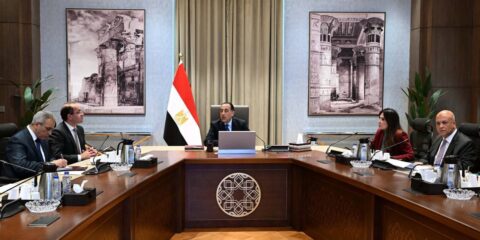
Dr. Mostafa Madbouly, Prime Minister, held a meeting today to follow up on plans and procedures for expanding seawater desalination projects, as well as to review efforts to localize the industry related to their components and operational requirements, Invest-Gate reports.
The meeting was attended by Mr. Ahmed Kouchouk, Minister of Finance; Eng. Randa El-Menshawy, Minister of Housing, Utilities and Urban Communities; Eng. Ahmed Omran, Deputy Minister of Housing for Utilities; Eng. Amr Khattab, Assistant Minister of Housing for Follow-up; Mr. Ater Hanoura, Advisor to the Minister of Finance for Public-Private Partnership Affairs; Eng. Ahmed Ali, Deputy Head of the New Urban Communities Authority for Utilities; Eng. Ahmed Gaber, Chairman of the Holding Company for Water and Wastewater; and Major General Asem Shokr, Deputy Chairman of the Holding Company for Water and Wastewater.
Strategic Focus on Water Security and Global Partnerships
At the outset of the meeting, the Prime Minister explained that the meeting aims to review a number of proposals submitted by major international companies specialized in desalination projects, stressing the government’s keenness to compare these proposals and select the best technically and financially, in a manner that ensures the highest quality standards and achieves national targets for localizing modern technologies.
Dr. Mostafa Madbouly affirmed that the water security file is at the top of the state’s strategic priorities, noting that expanding desalination projects has become an imperative necessity to keep pace with population growth and comprehensive development plans. He stressed that movement in this file comes in implementation of the directives of H.E. President Abdel Fattah El-Sisi, President of the Republic, regarding the necessity of localizing the industry related to seawater desalination plants, along with preparing integrated studies to ensure sustainable operation and transfer of the latest global technologies to the Egyptian market. He also emphasized the government’s readiness to provide all incentives and facilitation to companies and alliances to contribute to achieving this goal.
The Prime Minister directed the development of specific timelines for completing ongoing projects and overcoming any obstacles facing the targeted investments in this vital sector.
National Desalination Strategy 2020–2050
Eng. Randa El-Menshawy, Minister of Housing, Utilities and Urban Communities, reviewed the pillars of the strategic plan for seawater desalination “2020–2050,” which is based on four main pillars divided into six five-year plans, aiming to secure and provide drinking water needs to address natural population growth and meet the demands of the state’s comprehensive development plan.
The Minister also presented the current executive status of seawater desalination plants, noting that there are currently 129 existing plants with a total capacity of 1.411 million cubic meters per day, in addition to 19 other plants under implementation with a total capacity of 687 thousand cubic meters per day.
Eng. Randa El-Menshawy explained the procedures related to initiating the implementation of a number of desalination plants within the strategic plan and localizing the “desalination membranes” industry, noting that existing seawater desalination plants planned to be offered under the Public-Private Partnership (PPP) system have been identified in the governorates of Matrouh, the Red Sea, and North and South Sinai, with a total of 11 projects and capacities reaching 485 thousand cubic meters per day.
She also addressed the executive status of projects planned for future implementation under the Public-Private Partnership (PPP) system, totaling 14 projects with a total capacity of 2.36 million cubic meters per day.
The Minister of Housing also reviewed the proposals submitted by international companies to implement desalination plants, as well as proposals related to “localizing the desalination membranes industry in Egypt,” stressing that the Ministry is monitoring the status of the required plants to meet increasing needs, in a way that ensures the sustainability of water flows in the coming period.
Energy Rationalization and Cost Reduction Measures
During the meeting, Eng. Randa El-Menshawy also presented a report on consumption rationalization measures within the Ministry and its affiliated entities. The report included a number of measures taken in implementation of the directives of the Cabinet in this regard. These measures included taking all necessary steps to rationalize electricity consumption in road lighting and advertisements on main roads and public streets in governorates and new cities, while ensuring that public shops adhere to the prescribed closing times.
It also included directives issued by the New Urban Communities Authority to take the necessary measures to fully slow down major diesel-intensive projects for two months, particularly road projects that include (earthworks and asphalt works).
In this context, the Minister revealed that these measures have already resulted in a 40% reduction in energy consumption, as the consumed electrical capacity decreased from 13.5 million kWh/month to 8.1 million kWh/month. She added that this was reflected in the total cost value, which decreased from EGP 31.59 million/month before rationalization to EGP 18.954 million/month after applying these measures.
Eng. Randa El-Menshawy explained that work is currently underway to study the implementation of a remote-control system for lighting operations, aiming to save energy consumption and operation and maintenance costs without imposing any financial burdens on the state, whereby the cost of these works would be settled through “offsetting” against the savings achieved in consumption